
The Bulk Upload option in Discovery Commerce allows you to create new Facebook campaigns or update existing ones efficiently.
Create - Selecting the request type as 'Create' in the template allows you to set up new campaigns from scratch.
Update - Selecting the request type as 'Update' allows you to modify existing campaigns by adding new ads or ad sets, or updating creatives. Enter the Campaign ID of the campaign you want to update, and in the Shopalyst Saved Audience column, provide the exact name of the parent ad set under which the new ads or creatives should be created. Then, enter the required ad and creative details in the corresponding columns
You can choose between two template types:
- Standard Ads Template
- Quick Commerce Ads Template
The template selection depends on the type of campaign you're uploading.
Standard Ads Template :
The Standard template enables campaign creation with the following objectives: Sales, Awareness, Leads, Traffic and Engagement.
You can also create Meta Collaborative Ads (CPAS) through Standard Ads Template. CPAS allows brands to run collaborative ads using product catalogs, with shared measurement and attribution.
To create a CPAS campaign, add the Retailer Product Set ID in the existing input sheet. To know more about how to create Product Set ID Click here.
Once the Retailer Product Set ID is detected, the system automatically identifies the campaign as a Collaborative Ads (CPAS) campaign.
Quick Commerce Ads Template:
To know more about creating a quick commerce campaign click here.
Custom Templates
If you require a custom template, please communicate your requirements to the Shopalyst team. Once your needs are fully understood, they will implement the template within the Shopalyst Ad platform, making it readily available for your use.
For more details about templates, click here.
1. Navigate to Plan Upload:
- Go to the Plan Upload screen in the Ads Builder section and click Upload Media Plan.
2. Select Meta as the Platform:
- Choose Meta as the media platform and select the appropriate template from the dropdown menu.
- Select Auction as the buying type.
3. Review the Upload Template:
- The template contains two tabs: Instructions and Data Sheet. Carefully review the instructions before proceeding. Ensure all mandatory fields are filled in to ensure a successful upload.
- Under Column K, select "Discovery Commerce template" to configure Placements (choose from: Facebook Feeds, Instagram Feeds, or Facebook & Instagram Feeds).
- Under Column E, set the Campaign Objective (Traffic, Awareness, or Engagement)
For Lead Generation Campaigns:
Use the "Standard ads template" and go to the "Input Data" tab:
In Column C, enter "Leads" under Campaign Objective.
Set "FB Feed" or "IG feed" under Placement.
Enter the Lead Form Name in Column AC.
Set "Learn More" as the Call to Action in Column AD.
Refer to the visual screenshot for guidance.
- You can also choose Engagement as a Campaign Objective in Column C of the media plan upload sheet.
Steps to use:
Input "Engagement" under the "Campaign Objective" column in the media plan upload template and proceed to customize your targeting, budget, and schedule as usual.
 This enhancement empowers advertisers to create more meaningful connections with their audience, driving visibility and active engagement with their brand.

- You can use the Ad Set Scheduling column in the input sheet to configure daypart targeting by specifying delivery schedules, such as MON 09:00–11:00 or TUE 14:00–16:30.
- You can also set the Creative Type column to Facebook Post or Instagram Post to use existing posts for ad creation, or select FB Partnership or IG Partnership to create Partnership Ads.
4. Upload Your Template:
- Once you have completed filling out the template, upload it and click Submit. This action will redirect you back to the Plan Upload screen.
5. Preview Campaign Details:
- Click on the action button to preview the campaign details. Here, you can also download the original input sheet and review planned metrics such as impressions, reach, and CPM.

6. Check Upload Status:
- Review the status of your upload under the Plan Upload screen. The status icons represent different states as follows:
| Status | Color | Description |
| Saved |  | The campaign has been created and not yet published. |
| Queued |  | One of the campaign actions (like publish, reserve audience, etc) is in queue; waiting for completion. |
| Publish failed |  | The upload process has been failed. |
| Campaign published in platform |  | The campaign is published and live on the platform. |
| Campaign inactive in platform |  | The campaign is inactive on the platform due to one of the possible reasons:
|
7. Completion Time:
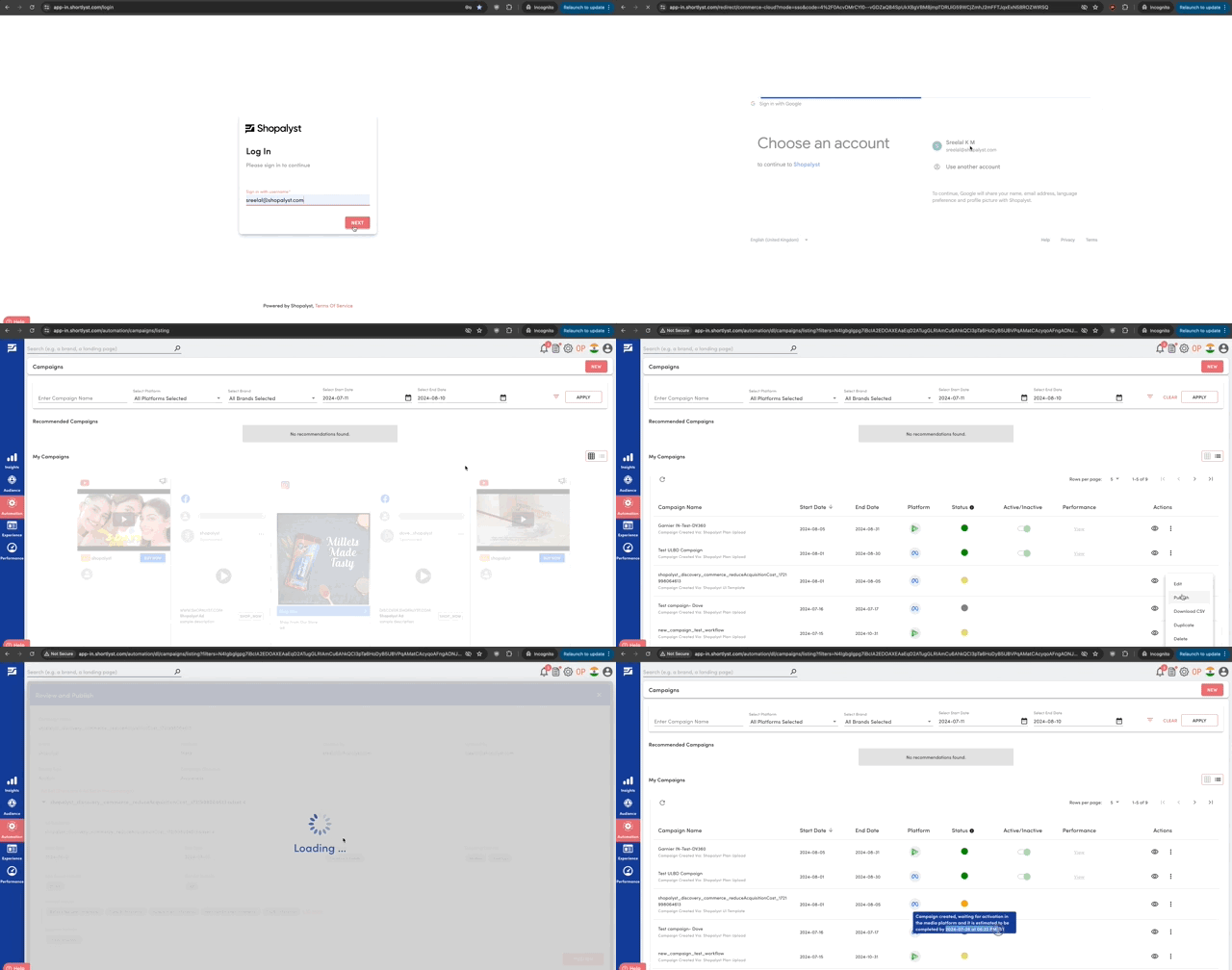
- The estimated time of completion can be viewed by hovering the mouse over the status icon.
8. Notification of Completion:
- Upon completion of the process, a notification will appear in the top-right corner of the application.
9. Publishing the campaign:
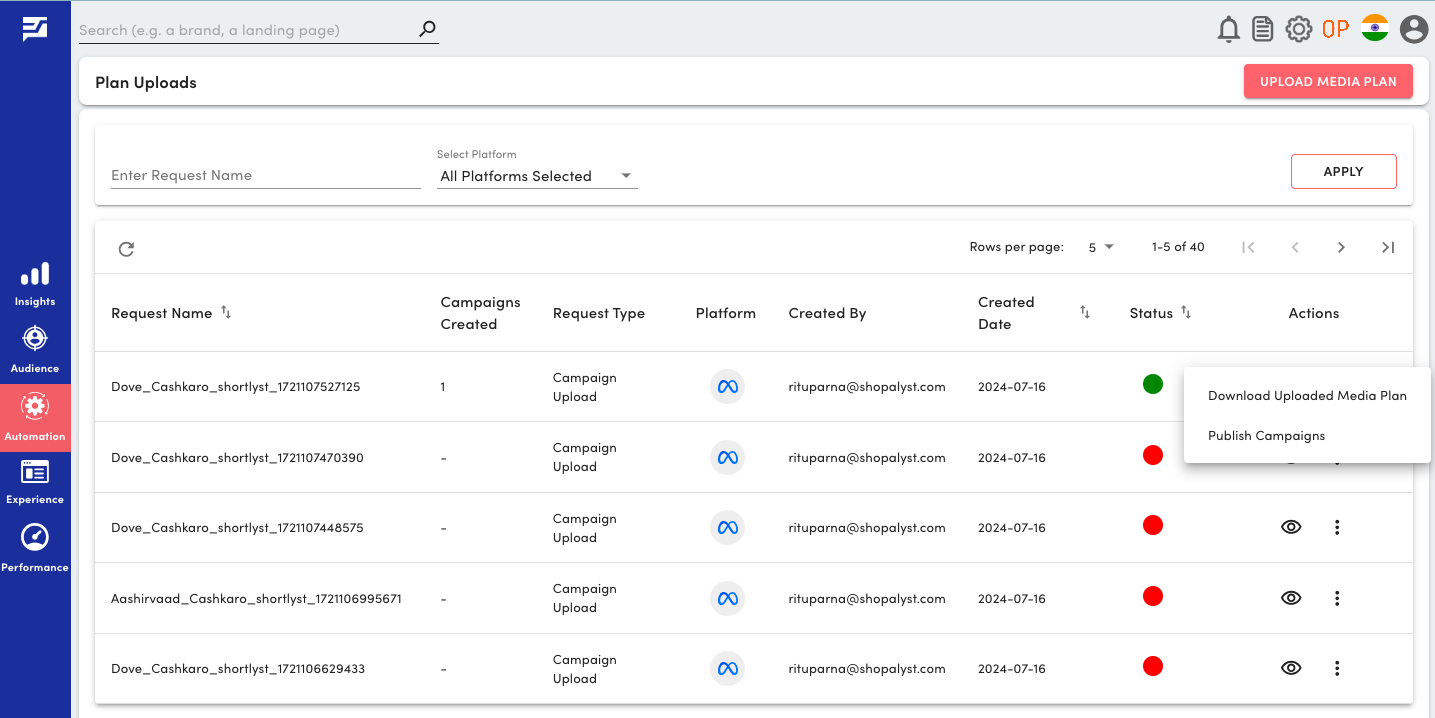
- Click on the three dots under the "Action" option to publish the campaign. You can also download the uploaded media plan for review before proceeding with the publication.
10. Campaign KPI Prediction:
- As soon as your campaign is published, you’ll be able to see predicted performance metrics for key indicators such as: Impressions, CPM (Cost per 1,000 impressions), Clicks, CPC (Cost per Click)
These forecasts give you a clear picture of your campaign’s expected performance trajectory over time. To know more click here
Click here to create a Reach and Frequency campaign using bulk upload
For more information on creating campaigns via bulk media upload, follow this link.
Looking for more help? Instructions to reach out to support are here.